Like so many people with SIBO, I have tried A LOT of different supplements and therapies to help restore my gut function. Sorting through which treatments might be best for you and worth the money can be a frustrating task. I want to share some of my experiences with different products/therapies to hopefully assist you to find the right tools to put in your SIBO tool box.
I would also like to state that I am in no way affiliated with any of these products. I am not trying to sell you anything, but rather to share experiences. My goal is to provide relevant information about each product, my experience with each product and my overall opinion on the product’s efficacy. It is also important to remember that every SIBO case is different. So, what may have worked for me, might not work for you (and vice versa). Let’s dive in!
Atrantil

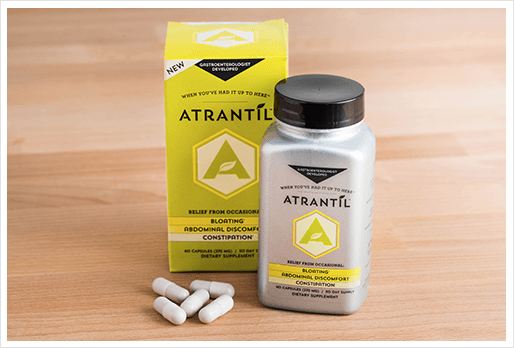
This supplement was designed by Dr. Kenneth Brown, a gastroenterologist, as a safe, all-natural and effective alternative to antibiotic treatment for SIBO-C. The product was mainly designed to target and kill methane producing archaebacteria that are associated with SIBO-C. The product has three weapons that are meant to work synergistically to wipe out those pesky gut bugs fast (when I took it, the company promoted that most SIBO cases resolve within 20 days of taking the therapeutic dose). These three plant derived weapons are:
- Peppermint leaf which calms the small bowel and slows down transit in the small intestine, which gives the other two extracts time to work.
- Quebracho Extract has high amounts of flavonoids that soaks up hydrogen, which starves the hydrogen loving archaebacteria of their preferred fuel source. It also weakens the cell walls. Overall, it creates a very unhospitable environment for the methane producing bacteria.
- Conker Tree Extract which serves as a natural antibiotic. This bacteria killer has a unique ability to shut down the enzyme that activates methane production in the bacteria.
After hearing about Atrantil, I knew that I had to try it. Theoretically, it seemed revolutionary and much more targeted than any other pharmaceutical/herbal antimicrobial for treating SIBO-C. With the buzz growing in the SIBO Facebook group and my gut issues still causing problems, I was happy to be the guinea pig. Plus, there was a money back guarantee!!
Was Atrantil effective at reducing my symptoms? Not really. I took the therapeutic dose for 20 days and didn’t really notice much of a difference. But, I think this could be a result of my symptoms being a result of large intestine imbalances and yeast overgrowth rather than SIBO. I had prior treatment for SIBO before I took Atrantil and had not been retested before I took it so I can’t be sure that I still had bacteria in my small intestine. I knew from an organic acids test that I still had markers of yeast and bacterial imbalances, but that doesn’t necessarily mean that I still had SIBO. Maybe Atrantil didn’t correct my symptoms, because SIBO wasn’t the culprit.
Although I didn’t have much luck with Atrantil, I am still excited and intrigued by it’s potential safe and targeted SIBO-C clearing effects. I have already discussed my apprehension about pharmaceutical antibiotics in a previous blog that you can read here. But, Atrantil’s action seems to target the pests in the small intestine without harming the good bacteria in the large bowel. Plus, Atrantil has shown strong efficacy in two recent studies.
One was a pilot study in which a randomized 2 week trial of Atrantil yielded a 91% decrease in bloating scores and 77% reduction in constipation scores. Another retrospective study on 24 patients that had failed other treatments, showed that a two week administration of Atrantil improved bloating symptoms fivefold, constipation threefold and pain threefold. Quality of life scores also increased by 88%!
While these studies are promising and exciting, but I do have a couple issues with them. First, Dr. Brown the creator of Atrantil, was an author of both studies, which means that there could be some conflict of interest there. Second, the studies were small. Third, I would have liked to see a before and after breath test to provide stronger evidence that Atrantil is clearing from the small intestine, not just symptom measure scores. I think it is unfair to compare the efficacy of Atrantil to antibiotics in treating SIBO, when antibiotics efficacy is measured through breath tests not symptom scores. To truly compare the two, Atrantil should conduct breath tests in the clinical trials.
Other reviews of Atrantil in the SIBO community seem mixed. Many people have reported symptom relief while taking Atrantil, while others seemed to not notice much of a difference. It also seemed that Atrantil only seemed to provide symptom relief while you take it. Like antibiotics, once discontinued, relapse is common. Atrantil is not a miracle cure and it doesn’t address the root of the SIBO.
As I have discussed in previous blogs, unless motility is restored, SIBO will continue to be a problem. Dysfunction in the Migrating Motor Cortex, thyroid problems, dysbiosis in the large bowel and even heavy metal toxicity are all major causes of delayed motility that should be addressed during treatment. I think Atrantil could be an effective tool in your tool box, but should be used in conjunction with other therapies.
In conclusion, I have mixed feelings about Atrantil. It could help some people, but it didn’t do much for me. For more information I highly recommend checking out this recent interview with Dr. Brown on Chris Kresser’s podcast.
Restore


Like Atrantil, I had first heard about Restore from some strong buzz in the online gut forums. Designed by Dr. Zach Bush, a crazy smart MD and researcher, Restore is a carbon-rich redox supplement that is designed to strengthen the tight junctions in the cells of the gut lining. By optimizing tight junction function, intestinal permeability and inflammation are reduced. Restore also strengthens the tight junctions in the blood brain barrier leading many patients to report increased mental clarity.
The tight junction effects of Restore are a result of the redox formulas ability to foster cell-to-cell communication and cellular repair. This not only enhances the signaling between the cells in our gut lining, but restores our bacterial communication network. In a fascinating interview, Dr. Bush describes how a balanced bacterial ecosystem is highly dependent on species to species communication. He claims that restore establishes cross-species communication that regulates what bacterial populations grow and which populations are suppressed.
In the interview Dr. Bush states “You can almost picture Restore being the healthy compost to create the soil that will support that bacterial life again. It’s a really nice positive feedback loop. You put Restore in, which is a sterile product, you get the communication network backup, every breath the patient takes she’s going to breathe in bacteria from her pet cat, from her dog, from her garden, from the neighbor walking in and giving her a hug. Everybody is introducing bacteria to her environment every day and when you get back that compost, it’s all able to get a foothold again and you can very quickly rebuild the system.”
I would love to see some clinical trials to support some of the claims that Dr. Bush has promoted. Most of the research supporting this product is from studies done in the lab petri dishes and not in human subjects. But, the scientific theory behind the product appears to be sound. I have also heard some positive antidotal evidence from others in the SIBO community.
Personally, I have used about 3 bottles of Restore and I have had some noticeable improvements from it. Surprisingly, mental clarity is the most positive outcome I have experienced from using Restore. I was not expecting for Restore to help with my brain fog, but it almost completely resolved it within the first week of taking it. My mood swings seem to also improve when I take Restore. Less bitch fits are always a good thing! My GI discomfort also improved, but has not completely resolved. Through my limited experience with the product, I believe that Restore, as advertised, tightened the barriers in my gut and brain.
I think Restore could be a great product to use both during and after herbal/pharmaceutical treatment in order to seal the gut lining and to rebalance the microbial populations in the large intestine that can often be handicapped after antibiotic treatment. Also, if you struggle with brain fog, I highly recommend this product. It was literally like switching my brain on for the first time in over a year.
MegaSporeBiotic

I have talked about probiotics extensively in a past post, but I want to revisit why I love MegaSpore in a little bit more detail.
Before I found MegaSpore, it seemed like I had tried every probiotic known to man. I spent tons of money on what I thought at the time were the highest potency products with over a 100 billion bugs per serving! I was determined to remodel my gut and I thought that the Lactobacillus and Bifidobacterium species were the keys to doing so. After trying at least 5 different products with negligible results, I lost faith in the efficacy of probiotics. Until, I found MegaSpore!
So what sets MegaSpore apart?
- Survivability! Probiotics can’t work their magic if they don’t survive the harsh acidic conditions of the stomach. Most of the popular probiotics and even fermented foods do not survive the transit to the large intestine. In fact, in a UK study that analyzed the survivability of 35 popular probiotic supplements that were high in Lactobacillus and Bifidobacterium species found that at optimal pH none of the strains survived with any viability. At weaker stomach acid levels, only 4 of the 35 strains analyzed showed any chance of survival to the large intestine. Another study looking at the survivability of a leading commercial probiotic (Ultimate Flora Critical Care) and 2 popular yogurt brands (chobani and dannon) found less than 1% survivability at optimal stomach acid levels (pH of 1.3).
The bacterial spores in MegaSpore, unlike lacto and bifido based products, remain in a dormant state until they reach the intestines, which guarantees 100% survivability. I think many of us assume that the higher the number of bacteria in the probiotic the better, but this is not the case. More is not better. While the probiotic might taut 50 billion cells, very few bacteria, if any at all, are going to survive. But, you can guarantee that all 4 billion cells from MegaSpores will survive the journey to the colon.
- They are found in nature! While lactobacillus and Bifidobacterium species make up the majority of the good bacteria in the human GI tract, you are unlikely to find large quantities of these strains from our environment. You actually inherit almost all of your bifido and lacto bacteria from you mother during vaginal delivery and through the mother’s breast milk. You shouldn’t need large quantities from outside sources, because you get all those good guys from your mama.
Unlike lacto and bifido species, spores are found all over our environment (especially in our soil and on our plants). We co-evolved with these bacteria and they have a strong ability to positively modulate the environment in the GI tract. Research even suggests that these spores contributed to certain developments in the human immune system. Also, we have binding sites in our gut for these particular bacteria, which allows them to colonize the gut very effective.
- Only probiotic supplement brand that contains Bacillus Clausii. This strain of bacteria has shown comparable efficacy as some broad-spectrum antibiotics in treating SIBO. In Europe, bacillus clausii is widely used as a gentler alternative to antibiotics in the treatment of SIBO. In addition, it is antibiotic resistant making it a good choice to use during any antibiotic treatment.
- Bacillus Subtilis and Bacillus Licheniformis can attack SIBO and other pathogens head on. B. Subtilis found in MegaSpore can produce 12 different types of antibacterial compounds, which can reduce the bacterial load in the small intestine and balance the bacterial population in the large intestine. In addition, B. Licheniformis produces bacitracin, a potent antibiotic compound that can attack the nasty gut bugs as well.
- Highest potency spore based probiotic on the market. With 4 billion spores, it delivers more spores than any other spore-based probiotic on the market.
- Nutrient Production. The strains in MegaSpore can synthesize a large number of nutrients such as Vitamin K2, B vitamins and carotenoids.
- Ability to Influence the pH and cause microbial shifts. MegaSpore creates an environment within the intestinal tract that is unhospitable to pathogenic bacteria while supporting good bacteria in the GI tract. So, if you have low bifido or lacto populations, taking megaspore will clear out the bad bacteria and create an optimal environment for these good bacteria populations to flourish. For instance, Bacillus coagulans produces lactic acid which reduces pH to levels that support good bacteria.
- Immune function. These spores help modulate the immune system by increasing your adaptive immunity and decreasing your innate immunity, which reduces the inflammatory response. The spores also help you fight infections by stimulating the production of B and T cells that help you fight infections in the body.
- Digestion. According to Kiran Krishnan, one of the microbiologists who helped formulate MegaSpore, the spores “produce all the digestive enzymes in the gut at potent levels.” Bacillus Licheniformis found in MegaSpore is particularly great at increasing protein digestion.
When I first started taking MegaSpore, I was underweight and dropping fast. I was eating 2500 calories a day without exercise and was in a chronic state of lethargy. Upon completing my first bottle of MegaSpore, I had gained 5 pounds and I was able to resume longer walks around my neighborhood. The spores were clearly essential in allowing my body to properly digest and absorb the foods I was eating. My poop quality and quantity also seemed to vastly improve while taking MegaSpore. I just feel better when I take it!
For these reasons, I would recommend giving MegaSpore a try if you are still struggling with gut issues. I think taking MegaSpore during and after antibiotics can also help prevent and correct any dysbiosis that results from antibiotic treatment. If you do decide to jump on the MegaSpore train, I would definitely start with a low dose (1/2-1 pill every other day) and titrate up to the therapeutic dose (2 pills everyday). I experienced some minor die-off when I stated at too high a dose, which resolved when I lowered my dose to one pill every other day.
For more information, you can check out this great article and presentation about MegaSpore.
I would love to hear about your experiences with any of these products! Please leave a comment below. Also, if you have any additional questions about my experiences with these products, feel free to leave a comment.
For more personalized supplement recommendations, consider working with me!